New editions for examination from 2023. These flexible resources have a skills development focus to help prepare the scientists of the future. Choose which components you need from the comprehensive series, comprising a coursebook, teacher's resource, workbook, practical workbook, and English language skills workbook and maths skills workbook. The series supports students learning science in English as a second language; learners who need more support with mathematical content in science, the development of essential practical skills, and the building of confidence and fluency with command terms and exam-style questions.
New editions for examination from 2023. We are working towards endorsement of these titles by Cambridge Assessment International Education. These flexible resources have a skills development focus to help prepare the scientists of the future. Choose which components you need from our comprehensive series, comprising a coursebook, teacher's resource, workbook, practical workbook, and English language skills workbook and maths skills workbook (coming in 2022).Through extensive research, including lesson observations, teacher interviews and work with our online research community (the Cambridge Panel) these resources have been designed to meet specific challenges through targeted support and the creation of dedicated components that focus on specific skills areas. The series supports students learning science in English as a second language; learners who need more support with mathematical content in science, the development of essential practical skills, and the building of confidence and fluency with command terms and exam-style questions.
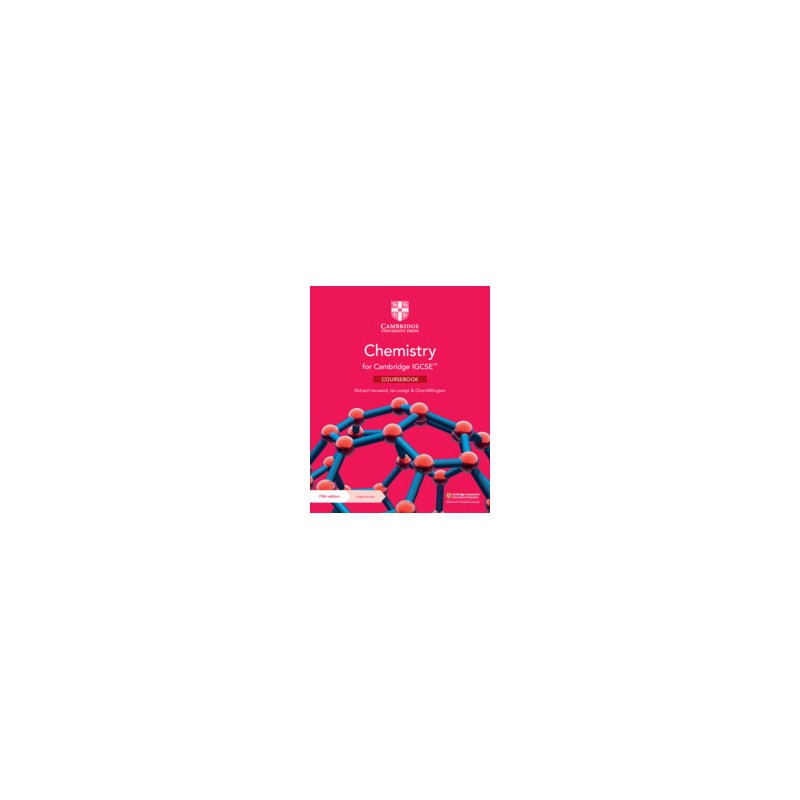
This print and digital coursebook has been developed from extensive research through lesson observations, interviews and work with our research community (the Cambridge Panel) to meet specific needs. Activities and questions develop students’ essential science skills. Accessible language and features support English as a second language learners. Exam-style questions build student confidence. Projects provide opportunities for assessment for learning, cross-curricular learning and developing skills for life. There are multiple opportunities to engage in active learning, such as discussions and debates, and self-assessment and reflection activities.
Features
Endorsed by Cambridge Assessment International Education for full syllabus coverage
Develops student scientific enquiry skills such as making predictions, recording observations, handling data, interpreting data and evaluating methods through the ‘Experimental skills’ feature
Project feature at the end of each chapter supports assessment for learning, cross-curricular learning, skills for life and differentiation
End of chapter exam-style questions build student confidence
Answers for all questions and exercises can be found online at www.cambridge.org/go
‘Experimental Skills’ feature gives students hands on experience and builds student understanding so they can put theory into a practical context
Features such as summaries and reflection boxes provide opportunities for students to focus on what they have learnt and practise their metacognitive skills
‘Science in Context’ features with open-ended discussion questions enable students to practise their English skills, interpret ideas in a real-world context, and debate concepts with other learners
Varied opportunities for learners to engage in active learning such as scripting a podcast or voiceover for a video, to creative work such as a comic strip poster, or oral work such as a debate or speech!
Activities build in complexity to support students’ learning journeys, and worked examples help them whenever they need to use an equation. All our resources are written in accessible language with features to support our English as a second language learners.
CONTENTS
States of matter
Atomic bonding
Chemical bonding
Chemical formulae and equations
Chemical calculations
Electrochemistry
Chemical energetics
Rates of reaction
Reversible reactions and equilibrium
Redox reactions
Acids and bases
Preparation of salts
The Periodic Table
Metallic elements and alloys
Reactivity of metals
Extraction and corrosion of metals
Chemistry of our environment
Introduction to organic chemistry
Reactions of organic compounds
Petrochemicals and polymers
Experimental design and separation techniques
Chemical Analysis
IGCSE-9781108951609
Data sheet
Key Stage | Phase
05. Key Stage 4
Year | Grade
13. IGCSE (Age 14 - 16)
Component
Core
Component Function
Learner’s Book
Publication Date
May 2021
Author(s)
Richard Harwood, Ian Lodge and Chris Millington
Format
Paperback | Other
First Examination
2023
Specific References
ISBN
9781108951609
Comments (0)
No customer reviews for the moment.
Your review appreciation cannot be sent
Report comment
Are you sure that you want to report this comment?
Report sent
Your report has been submitted and will be considered by a moderator.
Your report cannot be sent
Write your review
Review sent
Your comment has been submitted and will be available once approved by a moderator.
New editions for examination from 2023. These flexible resources have a skills development focus to help prepare the scientists of the future. Choose which components you need from the comprehensive series, comprising a coursebook, teacher's resource, workbook, practical workbook, and English language skills workbook and maths skills workbook. The series supports students learning science in English as a second language; learners who need more support with mathematical content in science, the development of essential practical skills, and the building of confidence and fluency with command terms and exam-style questions.