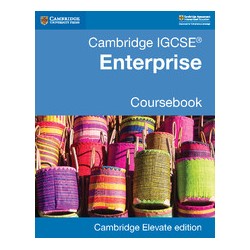
Bringing the world of business into the classroom, this coursebook helps students identify, plan, implement and evaluate their enterprise projects. The book has four sections based around the stages of the project with theory integrated throughout. This helps students relate their practical Enterprise project with the academic principles of business. With a foreword from the specialists at Cambridge Judge Business School, this coursebook helps students appreciate Enterprise skills in the world around them and talk to business people in their communities. Suggested answers to the exam-style questions are in the teacher’s resource.
Features
The coursebook is structured around the four stages of the coursework, supporting students and teachers with the aspect of the course they are least used to and most worried about.
Project Prompts help students with their enterprise projects by linking theory to practice.
International case studies, such as a dance academy in India and a charity in Zimbabwe, introduce students to enterprise around the world.
Exam-style questions help develop students’ skills and build their confidence with the subject.
Graphs and charts give students plenty of practice analysing different forms of information.
The free online teacher support is available on our website and helps to reassure teachers when delivering the course.
CONTENTS
Foreword from the Cambridge Judge Business School
Introduction to enterprise
Section 1: Identifying your enterprise project
Chapter 1: Setting up a new enterprise
Chapter 2: The skills and behaviours of enterprising people
Chapter 3: Enterprise opportunities, risk, legal obligations and ethical considerations
Template 1: How to conduct a PEST analysis
Template 2: SWOT Analysis
Chapter 4: Market research
Template 3: Conducting market research
Section 2: Planning your enterprise project
Chapter 5: Planning: objectives, business plans and action plans
Template 4: Action planning checklist
Chapter 6: Sources of finance
Template 5: Choosing sources of finance
Chapter 7: The concept of trade credit
Chapter 8: Financial terms and financial records: cash flow, break-even and income
Template 6: Projected Income and Expenditure
Chapter 9: Marketing: purpose, customer retention and marketing communications
Section 3: Implementing your enterprise project
Chapter 10: Negotiation
Chapter 11: Communication
Template 7: Planning and holding effective meetings
Chapter 12: Help and support for enterprise
Section 4: Evaluating your enterprise project
Chapter 13: Evaluating the success of your project
Glossary
Index
IGCSE-9781108440356
Data sheet
Key Stage | Phase
05. Key Stage 4
Year | Grade
13. IGCSE (Age 14 - 16)
Component
Core
Component Function
Learner’s Book
Publication Date
March 2018
Author(s)
Medi Houghton, Matthew Bryant and Veenu Jain
Format
Paperback | Other
First Examination
2020
Specific References
ISBN
9781108440356
Comments (0)
No customer reviews for the moment.
Your review appreciation cannot be sent
Report comment
Are you sure that you want to report this comment?
Report sent
Your report has been submitted and will be considered by a moderator.
Your report cannot be sent
Write your review
Review sent
Your comment has been submitted and will be available once approved by a moderator.
Bringing the world of business into the classroom, this coursebook helps students identify, plan, implement and evaluate their enterprise projects. The book has four sections based around the stages of the project with theory integrated throughout. This helps students relate their practical Enterprise project with the academic principles of business. With a foreword from the specialists at Cambridge Judge Business School, this coursebook helps students appreciate Enterprise skills in the world around them and talk to business people in their communities. Suggested answers to the exam-style questions are in the teacher’s resource.