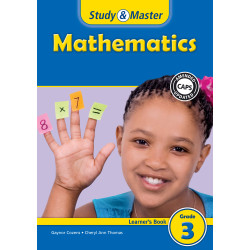
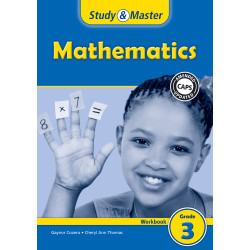
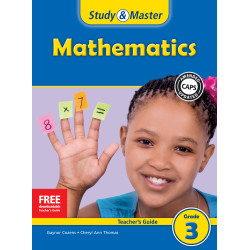
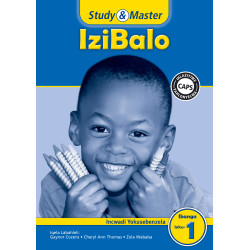
Mathematics
Subcategories
-
Afrikaans
Mathematics is a language that makes use of symbols and notations for describing numerical, geometric and graphical relationships. It is a human activity that involves observing, representing and investigating patterns and qualitative relationships in physical and social phenomena and between mathematical objects themselves. It helps to develop mental processes that enhance logical and critical thinking, accuracy and problem solving that will contribute in decision-making. Mathematical problem solving enables us to understand the world (physical, social and economic) around us, and, most of all, to teach us to think creatively.
Specific Aims
- To develop fluency in computation skills without relying on the usage of calculators.
- Mathematical modeling is an important focal point of the curriculum. Real life problems should be incorporated into all sections whenever appropriate. Examples used should be realistic and not contrived. Contextual problems should include issues relating to health, social, economic, cultural, scientific, political and environmental issues whenever possible.
- To provide the opportunity to develop in learners the ability to be methodical, to generalize, make conjectures and try to justify or prove them.
- To be able to understand and work with number system.
- To show Mathematics as a human creation by including the history of Mathematics.
- To promote accessibility of Mathematical content to all learners. It could be achieved by catering for learners with different needs.
- To develop problem-solving and cognitive skills. Teaching should not be limited to “how”but should rather feature the “when” and “why” of problem types. Learning procedures and proofs without a good understanding of why they are important will leave learners ill-equipped to use their knowledge in later life.
- To prepare the learners for further education and training as well as the world of work.
Grade R - 12
-
English
Mathematics is a language that makes use of symbols and notations for describing numerical, geometric and graphical relationships. It is a human activity that involves observing, representing and investigating patterns and qualitative relationships in physical and social phenomena and between mathematical objects themselves. It helps to develop mental processes that enhance logical and critical thinking, accuracy and problem solving that will contribute in decision-making. Mathematical problem solving enables us to understand the world (physical, social and economic) around us, and, most of all, to teach us to think creatively.
Specific Aims
- To develop fluency in computation skills without relying on the usage of calculators.
- Mathematical modeling is an important focal point of the curriculum. Real life problems should be incorporated into all sections whenever appropriate. Examples used should be realistic and not contrived. Contextual problems should include issues relating to health, social, economic, cultural, scientific, political and environmental issues whenever possible.
- To provide the opportunity to develop in learners the ability to be methodical, to generalize, make conjectures and try to justify or prove them.
- To be able to understand and work with number system.
- To show Mathematics as a human creation by including the history of Mathematics.
- To promote accessibility of Mathematical content to all learners. It could be achieved by catering for learners with different needs.
- To develop problem-solving and cognitive skills. Teaching should not be limited to “how”but should rather feature the “when” and “why” of problem types. Learning procedures and proofs without a good understanding of why they are important will leave learners ill-equipped to use their knowledge in later life.
- To prepare the learners for further education and training as well as the world of work.
Grade R - 12
-
IsiNdebele
Mathematics is a language that makes use of symbols and notations for describing numerical, geometric and graphical relationships. It is a human activity that involves observing, representing and investigating patterns and qualitative relationships in physical and social phenomena and between mathematical objects themselves. It helps to develop mental processes that enhance logical and critical thinking, accuracy and problem-solving that will contribute to decision-making.
To develop essential mathematical skills Grade R - 3 the learner should:
- develop the correct use of the language of Mathematics;
- develop number vocabulary, number concept and calculation and application skills;
- learn to listen, communicate, think, reason logically and apply the mathematical knowledge gained;
- learn to investigate, analyse, represent and interpret information;
- learn to pose and solve problems; and
- build an awareness of the important role that Mathematics plays in real-life situations, including the personal development of the learner.
Available in IsiNdebele for Grade R - 3
-
IsiXhosa
Mathematics is a language that makes use of symbols and notations for describing numerical, geometric and graphical relationships. It is a human activity that involves observing, representing and investigating patterns and qualitative relationships in physical and social phenomena and between mathematical objects themselves. It helps to develop mental processes that enhance logical and critical thinking, accuracy and problem-solving that will contribute to decision-making.
To develop essential mathematical skills Grade R - 3 the learner should:
- develop the correct use of the language of Mathematics;
- develop number vocabulary, number concept and calculation and application skills;
- learn to listen, communicate, think, reason logically and apply the mathematical knowledge gained;
- learn to investigate, analyse, represent and interpret information;
- learn to pose and solve problems; and
- build an awareness of the important role that Mathematics plays in real-life situations, including the personal development of the learner.
Available in IsiXhosa for Grade R - 3
-
IsiZulu
Mathematics is a language that makes use of symbols and notations for describing numerical, geometric and graphical relationships. It is a human activity that involves observing, representing and investigating patterns and qualitative relationships in physical and social phenomena and between mathematical objects themselves. It helps to develop mental processes that enhance logical and critical thinking, accuracy and problem-solving that will contribute to decision-making.
To develop essential mathematical skills Grade R - 3 the learner should:
- develop the correct use of the language of Mathematics;
- develop number vocabulary, number concept and calculation and application skills;
- learn to listen, communicate, think, reason logically and apply the mathematical knowledge gained;
- learn to investigate, analyse, represent and interpret information;
- learn to pose and solve problems; and
- build an awareness of the important role that Mathematics plays in real-life situations, including the personal development of the learner.
Available in IsiZulu for Grade R - 3
-
Sepedi
Mathematics is a language that makes use of symbols and notations for describing numerical, geometric and graphical relationships. It is a human activity that involves observing, representing and investigating patterns and qualitative relationships in physical and social phenomena and between mathematical objects themselves. It helps to develop mental processes that enhance logical and critical thinking, accuracy and problem-solving that will contribute to decision-making.
To develop essential mathematical skills Grade R - 3 the learner should:
- develop the correct use of the language of Mathematics;
- develop number vocabulary, number concept and calculation and application skills;
- learn to listen, communicate, think, reason logically and apply the mathematical knowledge gained;
- learn to investigate, analyse, represent and interpret information;
- learn to pose and solve problems; and
- build an awareness of the important role that Mathematics plays in real-life situations, including the personal development of the learner.
Available in Sepedi for Grade R - 3
-
Sesotho
Mathematics is a language that makes use of symbols and notations for describing numerical, geometric and graphical relationships. It is a human activity that involves observing, representing and investigating patterns and qualitative relationships in physical and social phenomena and between mathematical objects themselves. It helps to develop mental processes that enhance logical and critical thinking, accuracy and problem-solving that will contribute to decision-making.
To develop essential mathematical skills Grade R - 3 the learner should:
- develop the correct use of the language of Mathematics;
- develop number vocabulary, number concept and calculation and application skills;
- learn to listen, communicate, think, reason logically and apply the mathematical knowledge gained;
- learn to investigate, analyse, represent and interpret information;
- learn to pose and solve problems; and
- build an awareness of the important role that Mathematics plays in real-life situations, including the personal development of the learner.
Available in Sesotho for Grade R - 3
-
Setswana
Mathematics is a language that makes use of symbols and notations for describing numerical, geometric and graphical relationships. It is a human activity that involves observing, representing and investigating patterns and qualitative relationships in physical and social phenomena and between mathematical objects themselves. It helps to develop mental processes that enhance logical and critical thinking, accuracy and problem-solving that will contribute to decision-making.
To develop essential mathematical skills Grade R - 3 the learner should:
- develop the correct use of the language of Mathematics;
- develop number vocabulary, number concept and calculation and application skills;
- learn to listen, communicate, think, reason logically and apply the mathematical knowledge gained;
- learn to investigate, analyse, represent and interpret information;
- learn to pose and solve problems; and
- build an awareness of the important role that Mathematics plays in real-life situations, including the personal development of the learner.
Available in Setswana for Grade R - 3
-
Siswati
Mathematics is a language that makes use of symbols and notations for describing numerical, geometric and graphical relationships. It is a human activity that involves observing, representing and investigating patterns and qualitative relationships in physical and social phenomena and between mathematical objects themselves. It helps to develop mental processes that enhance logical and critical thinking, accuracy and problem-solving that will contribute to decision-making.
To develop essential mathematical skills Grade R - 3 the learner should:
- develop the correct use of the language of Mathematics;
- develop number vocabulary, number concept and calculation and application skills;
- learn to listen, communicate, think, reason logically and apply the mathematical knowledge gained;
- learn to investigate, analyse, represent and interpret information;
- learn to pose and solve problems; and
- build an awareness of the important role that Mathematics plays in real-life situations, including the personal development of the learner.
Available in Siswati for Grade R - 3
-
Tshivenda
Mathematics is a language that makes use of symbols and notations for describing numerical, geometric and graphical relationships. It is a human activity that involves observing, representing and investigating patterns and qualitative relationships in physical and social phenomena and between mathematical objects themselves. It helps to develop mental processes that enhance logical and critical thinking, accuracy and problem-solving that will contribute to decision-making.
To develop essential mathematical skills Grade R - 3 the learner should:
- develop the correct use of the language of Mathematics;
- develop number vocabulary, number concept and calculation and application skills;
- learn to listen, communicate, think, reason logically and apply the mathematical knowledge gained;
- learn to investigate, analyse, represent and interpret information;
- learn to pose and solve problems; and
- build an awareness of the important role that Mathematics plays in real-life situations, including the personal development of the learner.
Available in Tshivenda for Grade R - 3
-
Xitsonga
Mathematics is a language that makes use of symbols and notations for describing numerical, geometric and graphical relationships. It is a human activity that involves observing, representing and investigating patterns and qualitative relationships in physical and social phenomena and between mathematical objects themselves. It helps to develop mental processes that enhance logical and critical thinking, accuracy and problem-solving that will contribute to decision-making.
To develop essential mathematical skills Grade R - 3 the learner should:
- develop the correct use of the language of Mathematics;
- develop number vocabulary, number concept and calculation and application skills;
- learn to listen, communicate, think, reason logically and apply the mathematical knowledge gained;
- learn to investigate, analyse, represent and interpret information;
- learn to pose and solve problems; and
- build an awareness of the important role that Mathematics plays in real-life situations, including the personal development of the learner.
Available in Xitsonga for Grade R - 3